Look at the number.
The balance you don’t open can’t be planned for. Start with what’s actually there, not what you wish it were.
MONEY EDUCATION FOR REAL LIFE
No get-rich shortcuts. No shame about where you’re starting. Just a teacher-brain way to understand your money, protect it, and do the next useful thing.
“I’m not here to make you feel rich today. I’m here to make sure you actually are, later.” — Devon Ashe
Education, not personalized financial advice. Devon is a fictional educator persona; see disclosure.

AT THE DESK 01 / 03

01 / MEET DEVON
Devon’s brand story starts in a Midwest high-school economics classroom — not a trading floor.
In that story, she was explaining compound interest to teenagers while quietly working through her own student loans and her late husband’s medical bills. Her education in money happened at the kitchen table: a legal pad, a spreadsheet, side gigs, and years of doing the unglamorous thing again.
She doesn’t hide the expensive lessons: a rental property that drained two years of savings and $6,000 in crypto bought at the wrong moment. That honesty shapes the way she teaches. No victory lap. No secret system. Just plain words, real questions, and a reminder that a setback is data, not a verdict.
In Devon’s narrative, she still teaches one class a semester “so I don’t forget who I’m talking to.” It is the filter for everything this brand makes: if she couldn’t put it on a whiteboard for a bored 16-year-old, it doesn’t belong here.
Why that story is here: Devon Ashe is a fictional, AI-created educator persona. Her backstory and credentials are narrative, not a real person’s biography. The guides stand on their own as educational tools.
02 / THE APPROACH
Two different money problems. One way of thinking: slow down, ask better questions, then make one move you can repeat.
The balance you don’t open can’t be planned for. Start with what’s actually there, not what you wish it were.
A good decision survives a second look. Pressure and urgency are reasons to slow down, not speed up.
A small system you use on Wednesday beats a brilliant plan that only lasts until Monday.
03 / THE DIGITAL GUIDES
Start with a cash cushion, or learn how to test a pitch before it tests you. Both guides are built to be written in, not just read.

For the person who needs a first emergency fund and a calm, ordered path toward a first brokerage account.

For the moment a money pitch feels urgent, brilliant, or just confusing enough to make you skip your questions.
The buttons open the official Payhip product pages, where you can review the final price and files before purchase. This site does not collect payment details.
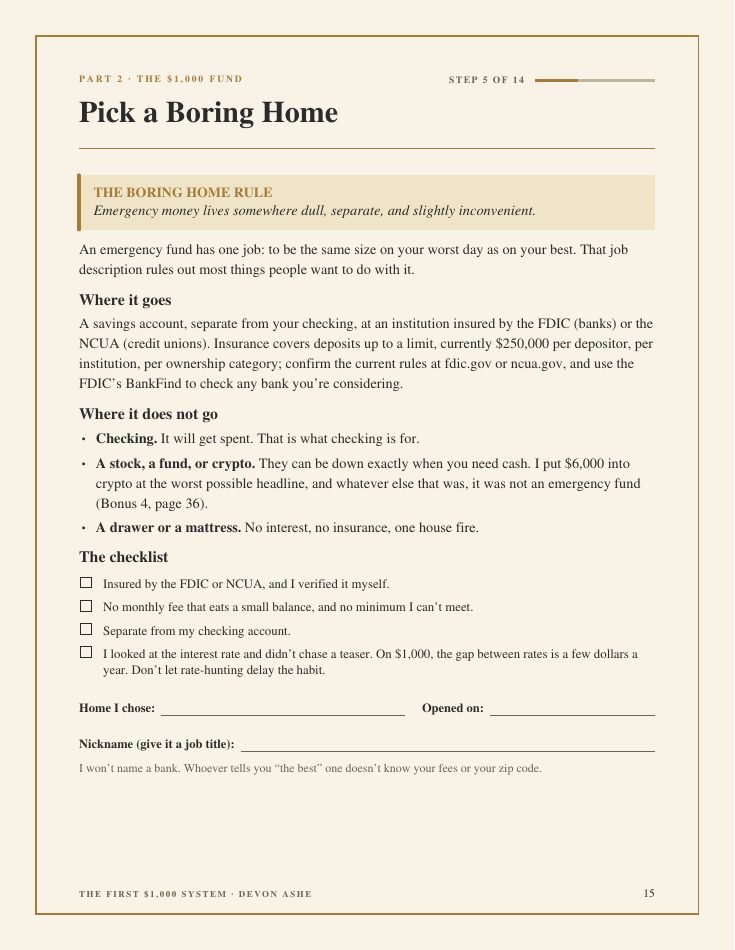
THE FIRST $1,000 SYSTEM / $26.99
The first $1,000 isn’t supposed to change your whole life. It is supposed to give your next unexpected bill somewhere to land besides a credit card.
This 40-page workbook begins with a Day-One Scorecard and a clear view of your balances, debts and leaks. From there, Devon’s method moves in order: a separate savings home, an automatic transfer, the first $250, a weekly check-in, and only then the questions to ask before opening a brokerage account.
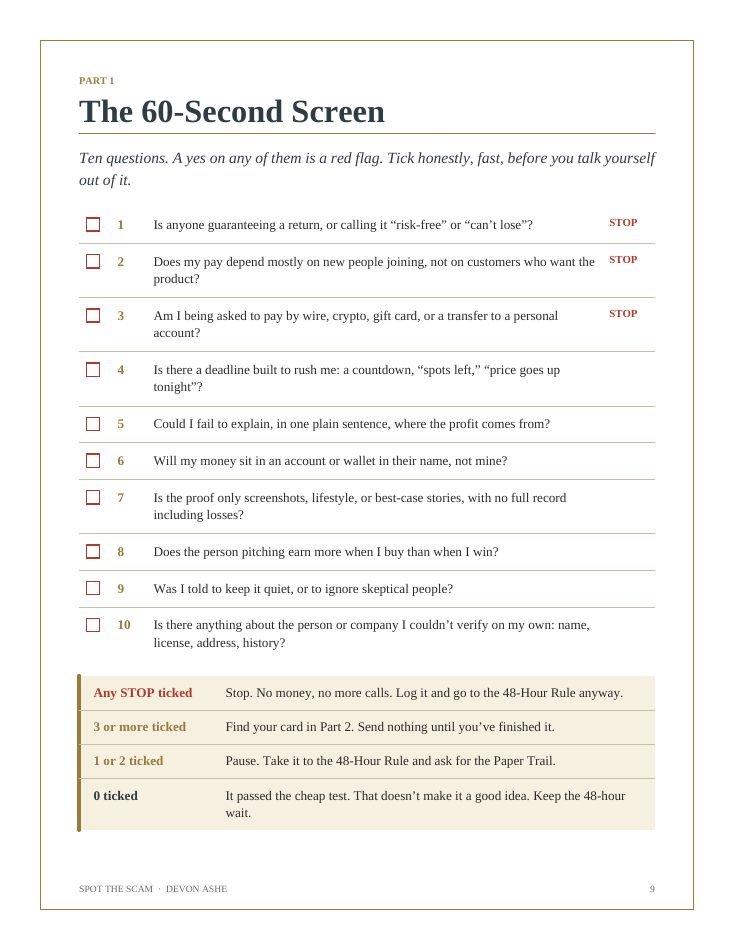
SPOT THE SCAM / $14.99
“Only three spots left” is not a reason to decide. It is a reason to reach for the checklist.
This 29-page pack gives you a repeatable way to screen a pitch, investigate the type of offer, wait 48 hours, and keep a record of what you learned. It includes eight pitch cards covering recruitment loops, passive-income courses, signal sellers, guru landlords, turnkey stores, guaranteed returns, trading bots, and a friend’s “opportunity.”
WHERE DO YOU BEGIN?
THE HONEST ANSWERS
That’s kind of the whole point.
No. The guides are educational tools. They don’t recommend a specific bank, broker, investment, stock, or course of action for your individual situation. Investing involves risk, including loss.
No. Devon Ashe is a fictional, AI-created educator persona. Her teacher backstory, losses and credentials are part of the character’s narrative; they are not a real person’s verified biography. The worksheets and questions are meant to be judged on their own merits.
The Payhip pages currently list The First $1,000 System at $26.99 and Spot the Scam at $14.99. The first listing includes a 40-page PDF workbook and a seven-tab XLSX companion spreadsheet; the second includes a 29-page PDF checklist pack. Review the listing and final price on Payhip before purchasing.
Yes. The purchase buttons take you to each product’s Payhip page. Payhip handles checkout and digital-file delivery; this website does not collect card details.
No. A checklist cannot certify an offer as safe, and a workbook cannot promise that you will save a certain amount or earn a return. Both are meant to help you ask better questions and build a workable process.
DEVON ASHE / BUILD WEALTH. CREATE FREEDOM.
Sometimes it’s opening the balance. Sometimes it’s waiting 48 hours. Pick the guide that meets you there.
CHECKOUT & DIGITAL DELIVERY ON PAYHIP · PLEASE REVIEW YOUR ORDER THERE